
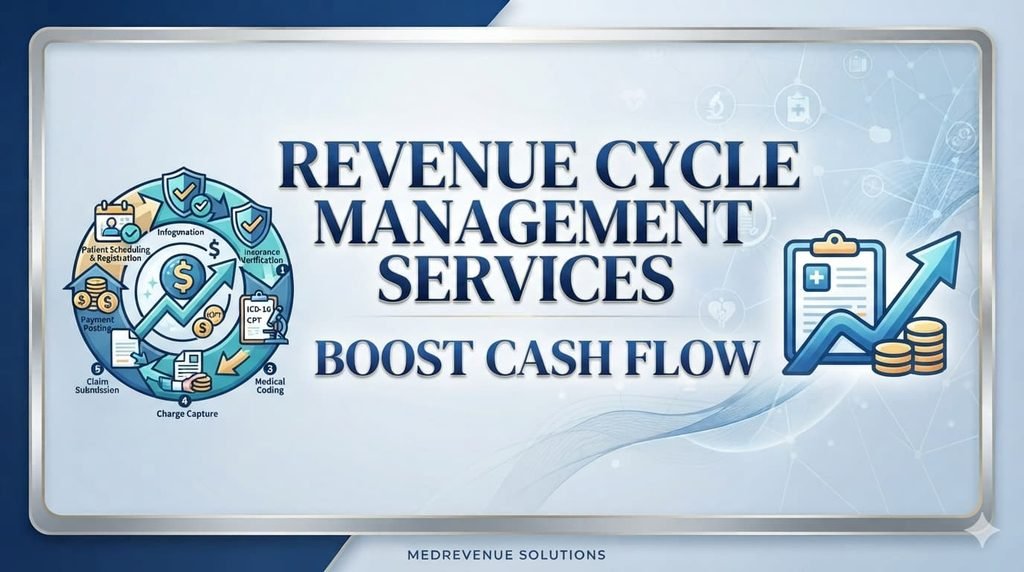
Revenue Cycle Management Services That Stop the Cash Leak
Revenue is leaking. You just can’t see it.
Revenue cycle management services track every dollar from the moment a patient books an appointment to the day the final balance clears, and they plug the small holes that quietly drain a practice.
Most owners feel it before they see it. Cash arrives late, staff juggle payer calls between patients, and the A/R report looks like a bad game of Jenga, one pulled claim away from tumbling down on everybody.
What Revenue Cycle Management Services Actually Include
Let’s get into the nitty-gritty. RCM services cover the whole money trail.
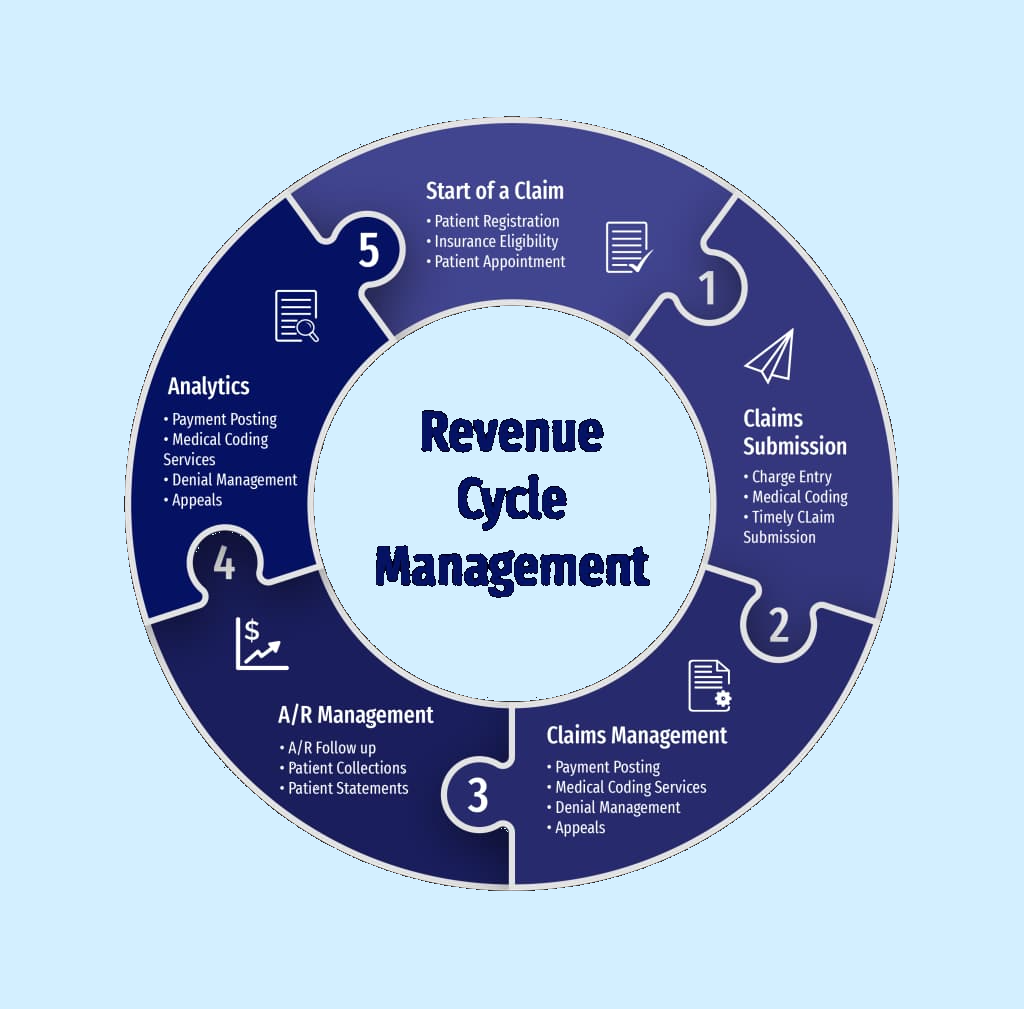
Scheduling and eligibility checks come first, then charge capture, medical coding, claim submission, payment posting, denial management, patient billing, and collections, and each step hands the baton to the next one.
Drop the baton once and the whole relay slows down.
Healthcare Revenue Cycle Management Services: Three Stages, Three Kinds of Leaks
Healthcare revenue cycle management services work best when every stage talks to the next one, because a mistake at registration shows up months later as a denial that nobody can explain.
Think of it in three chunks. Each one leaks in its own way.
| Stage | What happens | Where the money leaks |
|---|---|---|
| Front end | Scheduling, registration, eligibility, prior authorization | Wrong insurance details, missing authorizations |
| Middle | Charge capture, coding, claim submission | Missed charges, undercoding, coding mismatches |
| Back end | Payment posting, denial management, patient collections | Unworked denials, missed appeal deadlines, aging A/R |
Front-end mistakes are sneaky because they look harmless. A typo in a policy number takes ten seconds at the desk, yet it can turn into a denied claim that eats weeks of follow-up work down the road.
Revenue Cycle Management for Healthcare Providers: Who Needs It?
Everybody, honestly.
Solo docs, multi-site groups, urgent care chains, and specialty clinics all share the same headache: payers change the rules faster than staff can memorize them, and the paperwork never takes a day off.
Physician RCM has its own quirks. Evaluation and management levels, modifiers, and payer-specific documentation rules decide whether a busy clinic gets paid in full or watches revenue erode quietly, one underpaid visit at a time.
RCM Hospital Teams: Bigger Stakes, More Moving Parts
An RCM hospital operation is a different beast.
Inpatient stays, DRG payments, prior authorizations, charity care policies, and multiple departments feeding one account mean a single patient bill can touch a dozen people before a payer ever sees it.
RCM Softwares: Helpful, Not Magic
Software helps. It doesn’t think.
RCM softwares automate eligibility checks, claim scrubbing, and payment posting, yet a tool still needs a trained human to decide what to appeal, what to write off, and what to escalate.
We’ve seen it plenty of times: a practice hires a pricey tool, skips the follow-up work, and wonders why the bank balance looks exactly the same six months later.
A shiny dashboard with nobody watching it is just wallpaper.
Our approach pairs your existing system with people who actually read the reports and act on them, so nothing sits unattended while payer deadlines tick down in the background.
In-House, Outsourced, or Hybrid?
Some practices keep RCM in-house and do fine.
Others hit a wall when volume grows, staff turn over, or payer rules shift, and outsourcing becomes the sensible move rather than a last resort that arrives after cash flow has already taken a hit.
Hybrid works too. Keep front desk tasks local, hand off coding, denials, and collections to specialists who live and breathe payer rules all day, and watch your internal team finally exhale.
Healthcare RCM Companies and RCM Providers: How to Choose
Plenty of healthcare RCM companies promise the moon. Few show their homework.
When comparing RCM providers, ask for real benchmarks like clean claim rate, first-pass acceptance, net collection rate, and days in A/R, and make them explain how those numbers changed for clients like you.
Here’s a quick gut check before you sign:
- Pricing: percentage of collections, flat fee, or a hybrid, and what extra charges hide in the fine print
- Contract length
- Specialty experience
- HIPAA safeguards and a signed BAA
- Reporting
- Who owns your data if you leave?
- Software compatibility
- Denial turnaround
- References
- A real person who answers the phone, not just a ticket queue
Metrics Worth Watching
Numbers don’t lie, but they do hide.
A healthy collection total can mask a pile of aging claims nobody worked, so we track days in A/R, denial rate, and clean claim rate side by side instead of staring at one number.
Here’s our take: the denial rate is the most honest number on the page, because it shows exactly where your process cracks, and a rate that never budges is definately a red flag worth chasing.
Working With APLUS RCM
APLUS RCM is a medical billing company, and our revenue cycle management services cover the pieces that decide whether you get paid: eligibility, coding, claims, denials, payment posting, and patient collections.
Our medical RCM services and healthcare RCM services are built for practices that want fewer surprises on the monthly report, and they connect to the software you already use.
Nothing fancy. Just steady follow-up.
Want healthcare RCM solutions without the hard sell? Same here. We’d rather run a sample review on a small batch of your own claims and let the numbers do the talking, so you can judge us on results instead of a brochure.
Frequently Asked Questions
What are the 9 steps in RCM?
Different sources slice the cycle differently, with some counting 5 steps and others 7 or 10. The nine-step version most providers use looks like this:
- Patient pre-registration
- Eligibility verification and financial clearance, including prior authorization when a payer requires it
- Charge capture
- Medical coding
- Claim submission
- Payer adjudication and payment posting
- Denial management and appeals
- Patient statements
- Collections and A/R follow-up, which is the last stretch where unpaid balances get chased down before they age out
Skip or rush any one of them and the damage usually shows up three steps later.
What are revenue cycle managed services?
Revenue cycle managed services mean handing some or all of your RCM work to an outside team. That can include eligibility checks, coding, claim submission, payment posting, denial management, and patient collections.
You can outsource the whole cycle or just the parts that give your staff headaches. Many practices start with denials and A/R, then add more once they see the results.
Is RCM the same as medical billing?
Not quite. Medical billing is one piece of RCM.
Billing covers preparing and submitting claims and following up on payment, while RCM wraps around it and includes everything before the claim (registration, eligibility, authorizations) and everything after it (denials, patient balances, reporting). Think of billing as the engine and RCM as the whole car.
What is RCM in healthcare?
RCM stands for revenue cycle management. In healthcare, it’s the financial process that tracks a patient’s account from the first appointment request to the final payment.
It connects the clinical side (the care you delivered) with the financial side (the money you earned for it), and it exists to make sure those two actually match.
How does revenue cycle management work in medical billing?
In medical billing, RCM acts as the quality control around every claim. Before the visit, the team verifies coverage. After it, coders turn the documentation into accurate codes, billers send clean claims, and staff post payments and work any denials.
Whatever insurance leaves unpaid gets billed to the patient, and reports track how fast and how fully the practice is getting paid, so problems show up on a dashboard instead of in the bank account.
What are the revenue cycle management steps?
The core steps run in this order: registration, eligibility and authorization, charge capture, coding, claim submission, payment posting, denial management, patient billing, and collections. The full breakdown is in the 9-step answer above.
The order matters. A mistake in step one, like a wrong insurance ID, can quietly sink a claim at step five.
Is there a healthcare revenue cycle certification?
There isn’t one single, universal RCM certification, but several respected credentials cover parts of the cycle. HFMA offers the Certified Revenue Cycle Representative (CRCR) for patient access and revenue cycle staff. AAPC offers certifications such as the Certified Professional Biller (CPB) and Certified Professional Coder (CPC), and AHIMA offers coding credentials such as the CCS.
Requirements and exam details change, so check each organization’s website before enrolling. When hiring a partner, ask which certifications their team holds.
How do I choose among healthcare RCM companies?
Look past the sales pitch and ask for numbers: clean claim rate, denial rate, net collection rate, and days in A/R. Then ask how those numbers changed for practices similar to yours.
Also check specialty experience, HIPAA safeguards, contract terms, who owns your data if you leave, and whether you’ll talk to a real person when something goes sideways. A cheap contract that leaves you chasing answers isn’t cheap for long.
APLUS RCM is happy to walk through our process and numbers whenever you’re comparing options, with no pressure to sign anything.