
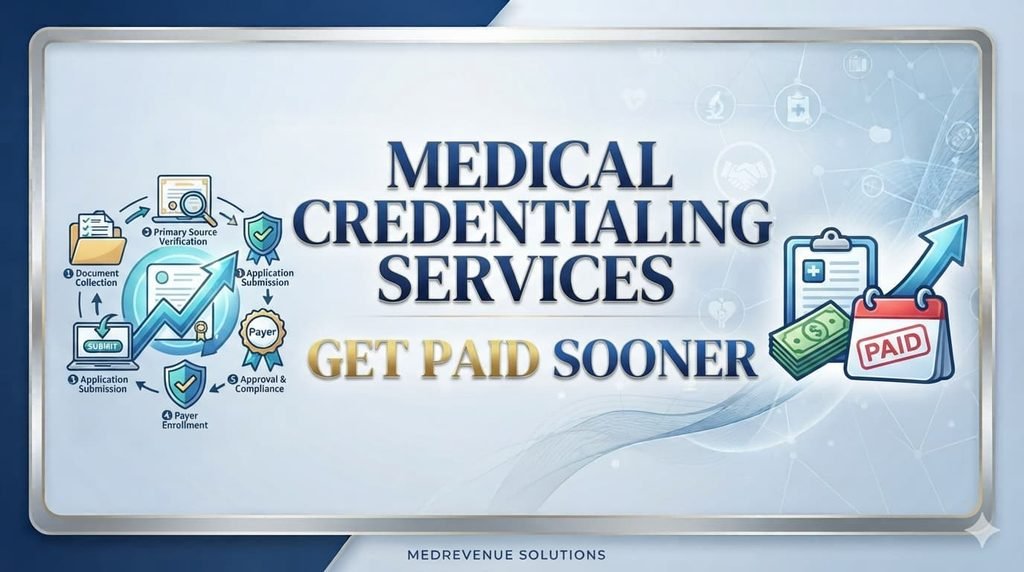
Medical Credentialing Services That Get Your Providers Paid Sooner
Credentialing is paperwork purgatory.
Medical credentialing is how insurers and facilities verify that a clinician is who they claim to be, licensed, trained, insured, and clean on the record, before that clinician sees a single covered patient.
Most practices learn this the hard way, usually after hiring a great new provider who then sits idle for three months because a payer never received one missing signature, and the schedule bleeds money.
Medical Credentialing, Minus the Jargon
It’s a background check with a binder.
Insurers do it so they can list a provider in their network, hospitals do it to grant priveleges, and both sides want proof of education, licenses, board status, malpractice history, and work record.
No enrollment, no payment. Red tape, yes, but it’s the red tape that decides whether your claims get paid.
Why Credentialing Takes So Long
Payers don’t hurry.
Timelines often stretch from 60 to 120 days or more, and every day a provider can’t bill is revenue that no amount of overtime will ever win back.
Here’s our take: most delays start inside the practice, with an expired document or a stale CAQH profile that nobody noticed until the payer sent the application back, and by then weeks are gone.
Provider Credentialing vs. Hospital Credentialing vs. Vendor Credentialing
These three get mixed up constantly.
They’re related, but they’re different animals, and mixing them up is a quick way to waste a month filling out the wrong forms for the wrong organization while the right one waits.
| Type | Who it’s for | What gets checked | Who asks for it |
|---|---|---|---|
| Provider credentialing | Physicians, nurse practitioners, therapists, other clinicians | License, education, board status, malpractice history, work history | Insurance payers |
| Hospital credentialing | Clinicians who want to work in a facility | The same core checks, plus facility-specific approval to practice and peer references | Hospital medical staff office |
| Vendor credentialing | Reps, suppliers, contractors, staffing agencies | Insurance, immunizations, background screening, HIPAA and safety training | Hospitals and health systems |
One unlocks reimbursement, the other unlocks the building.
Physician Credentialing Services: What Actually Gets Checked
Physician credentialing services start with primary source verification.
That means checking credentials directly with whoever issued them, not trusting a photocopy, and it covers medical school, residency, state licenses, board certification, DEA registration, and exclusion databases like the OIG list.
Details matter here.
A transposed digit in an NPI or a lapsed malpractice certificate can send the whole application back to square one, and the payer rarely calls to tell you.

Hospital Vendor Credentialing: The Side Door Nobody Mentions
Not every person walking into a hospital is a clinician.
Hospital vendor credentialing covers device reps, equipment suppliers, contractors, and staffing agencies who need approval before they enter patient areas, and hospitals typically want proof of insurance, immunizations, background screening, and compliance training on file.
Vendor credentialing gets overlooked because it doesn’t involve insurance billing, yet it can hold up a product launch or a contract just as fast as a stalled payer application.
Hospitals don’t bend on this.
ABA Credentialing Services
Applied behavior analysis practices face their own wrinkle.
ABA credentialing services usually focus on getting BCBAs and sometimes BCBA-Ds enrolled with commercial payers and state Medicaid programs, and the rules shift from state to state and plan to plan.
Supervision rules matter too. Payers often have their own policies on who can bill under whom, and getting that wrong means claims bounce even when the therapy was delivered perfectly and the family showed up every single week.
Paperwork You’ll Need Before Anyone Starts
Gather this early:
- Current CV with no unexplained gaps, because payers love asking about time off, and a short explanation up front beats a week of back-and-forth later
- State license(s)
- DEA registration, where it applies
- Board certification
- NPI
- Malpractice insurance certificate with current dates, not last year’s copy
- Education and training records
- W-9
- Hospital affiliations
- Professional references
- CAQH ProView profile, fully updated and attested
Short on one item? Start tracking it down today.
Where Credentialing Applications Go to Die
Expired documents. Mismatched addresses across the license, the NPI record, and the CAQH profile. Skipped fields. A profile nobody re-attested.
Then there’s the follow-up problem: payers rarely send friendly reminders, so applications sit in a queue until somebody picks up the phone, and that somebody needs to know who to ask and what to say.
Re-credentialing sneaks up on busy offices, typically every three years, and a lapsed enrollment can freeze payments overnight while everyone scrambles to figure out which deadline got missed and who was supposed to watch it.
Working With APLUS RCM
APLUS RCM is a medical billing company, which means we see credentialing from the side that matters most: wether claims actually get paid once the provider finally starts seeing patients.
Our medical credentialing services cover provider credentialing, physician credentialing services, payer enrollment, CAQH maintenance, and re-credentialing tracking, and they sit right next to our billing team so nothing gets lost between departments.
We also support ABA practices with payer and Medicaid enrollment, help with hospital credentialing paperwork, and handle vendor credentialing for suppliers who need access to facilities, so one team covers the whole list.
No hard sell here.
If you’re curious where your pending applications stand, we’re glad to take a look and give you an honest read, even if that read is that you’re on track and don’t need us.
Frequently Asked Questions
Which platforms are best for medical credentialing?
There’s no single winner, because the right tool depends on your size and on whether you’re credentialing clinicians, vendors, or both. CAQH ProView is the usual starting point, since most commercial payers pull provider data from it. For tracking verifications and expiring documents, groups and hospitals often look at tools such as symplr, Verifiable, and Medallion.
Compare pricing, integrations, and support before choosing, because features change. Remember too that software doesn’t chase payers for you. Someone still has to watch each application.
What is the medical credentialing process?
The exact steps vary by payer and facility, but the usual path looks like this:
- Collect documents
- Complete or update the CAQH profile and the payer’s application
- Primary source verification of licenses, education, and certifications
- Committee review by the payer or hospital
- Approval, contracting, and an effective date
- Re-credentialing, typically about every three years
Ballpark timelines run from 60 to 120 days, and sometimes longer, so start early.
Who is a credentialing specialist and what do they do?
A credentialing specialist is the person who gathers a provider’s documents, verifies them, submits applications to payers or hospitals, and follows up until approval comes through. They also track expiration dates for licenses, DEA registrations, and malpractice coverage, and they handle re-credentialing so nothing lapses.
Why does APLUS RCM stand out in medical credentialing?
Because credentialing and billing live under one roof here. Our credentialing team works alongside our billing specialists, so we see exactly how an enrollment delay turns into denied or held claims, and we plan around it.
We track expiring documents and re-credentialing dates, give you clear status updates instead of silence, and support everything from solo providers to multi-site groups, ABA practices, and vendors who need hospital access.
What are the medical credentialing requirements?
Requirments vary by payer, state, and facility, but most ask for a current state license, education and training records, board certification where it applies, an NPI, DEA registration if you prescribe, proof of malpractice insurance, a detailed work history, references, and an up-to-date CAQH profile. Hospitals add their own forms and peer references on top.
What do medical credentialing services include?
Good medical credentialing services handle document collection, CAQH setup and maintenance, payer applications, primary source verification, follow-ups with payers, contract tracking, and re-credentialing reminders. Some providers also add hospital credentialing support, ABA enrollment, and vendor credentialing. Ask for a clear list of what’s included before you sign anything.
Is there medical credentialing training for staff?
Yes. NAMSS offers certifications for credentialing professionals, including the Certified Provider Credentialing Specialist (CPCS), and many practices also rely on payer webinars, CAQH resources, and on-the-job coaching. Requirements and exam details change, so check the NAMSS website before enrolling anyone.
What skills does a medical credentialing specialist need?
Sharp attention to detail comes first, followed by organization, persistence on the phone, and clear writing. A good specialist also knows payer rules, state licensing boards, CAQH, and accreditation standards such as NCQA, and stays calm when a payer asks for the same document for the third time.